



Teaching and learning
Our Teaching and Learning Framework is built around three interconnected elements:
We believe that consistency does not mean uniformity. Rather than prescribing a particular structure or sequence for every lesson, our framework provides teachers with a shared repertoire of effective strategies and routines. Teachers use their professional and subject expertise to select and adapt these according to what is being taught and the needs of the students in front of them.
We have high expectations for every student. We believe that all students should experience an ambitious curriculum, be challenged to think deeply and be supported to produce work of which they can be proud.
By establishing strong habits and consistently reinforcing expectations, we create classrooms in which students feel safe, supported and ready to learn.
Great teaching is rooted in strong subject knowledge. Our teachers are subject specialists who understand both the content they teach and how students develop knowledge and expertise within their disciplines.
Our curriculum is carefully sequenced so that new learning builds upon what students already know. Teachers make connections between prior and new knowledge, explicitly teach the vocabulary and concepts students need and provide opportunities for students to practise and apply their learning.
Our HQIT framework brings together evidence-informed approaches which support all students to access ambitious learning. These strategies are embedded within everyday teaching, reducing barriers and enabling students to participate successfully. Where individual barriers remain, teachers use their knowledge of students, including Individual Learning Plans (ILPs), to make appropriate reasonable adjustments and provide additional support.
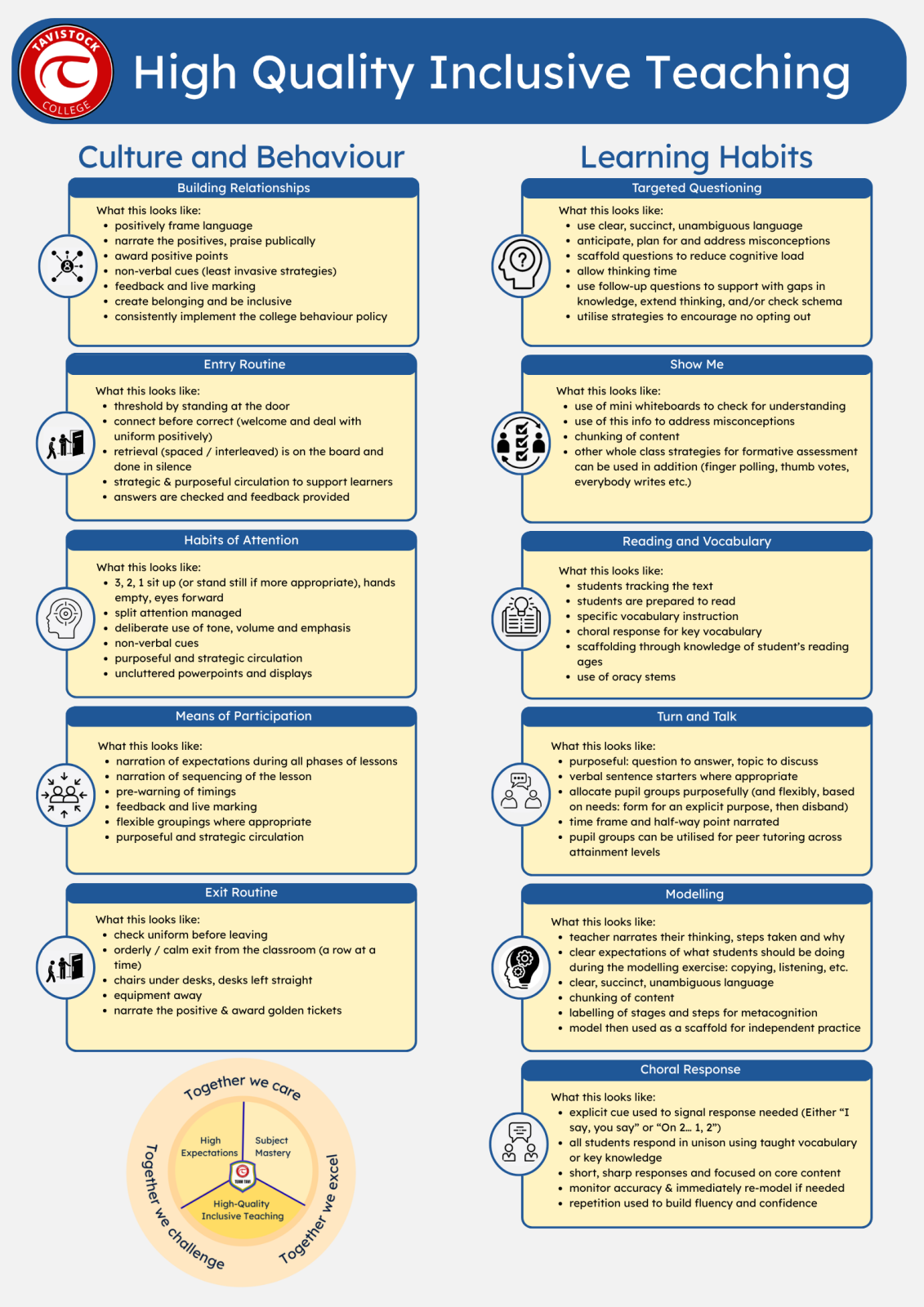
Culture and Behaviour
Teachers build positive relationships with students, combining warmth and care with clear boundaries and high expectations.
Students are welcomed positively at the door and supported to begin lessons calmly and purposefully. Clear routines allow students to settle quickly and maximise learning time.
We explicitly teach students how to give their attention when it is needed. Teachers use a consistent 3, 2, 1 cue, followed by clear expectations such as hands empty, eyes forward, or an appropriate equivalent. This helps students develop the habits required to listen, think and learn effectively.
Teachers establish clear routines for how students participate in learning. This may include questioning, discussion, written responses, mini whiteboards and other approaches which enable teachers to involve all students rather than relying only on volunteers.
Lessons finish in a calm and orderly way, with teachers maintaining high expectations through to the end of the lesson and supporting a purposeful transition to students' next activity.
Learning habits
Teachers use questioning purposefully to check understanding and deepen thinking. Questions are targeted across the classroom so that all students are expected and supported to participate. Teachers probe, clarify and develop responses, addressing misconceptions as they arise.
Teachers regularly gather responses from all students to establish what they know and understand. Mini whiteboards are an important part of this approach, allowing teachers to quickly identify misconceptions, adapt their teaching and ensure that every student's understanding is visible.
Reading and vocabulary are explicitly taught across the curriculum. Teachers identify and teach important subject-specific and academic vocabulary, support students to read increasingly challenging texts and model how expert readers make meaning within different subjects.
Structured partner discussion gives every student the opportunity to rehearse and develop their thinking. Teachers provide clear questions and expectations before students discuss their ideas, before bringing the class back together to share and refine responses.
Teachers make expert thinking visible. Through worked examples, demonstrations and 'thinking aloud', teachers show students both what successful work looks like and the processes required to produce it. Models can then be broken down, discussed and used to support students towards increasingly independent practice.
Where appropriate, teachers use whole-class verbal responses to increase participation and strengthen recall. Choral response can provide repeated practice of important vocabulary, knowledge or processes while enabling every student to participate.
An evidence-based and developing approach
Our Teaching and Learning Framework is supported by ongoing professional development. Staff engage in whole-College and subject-specific training, coaching, observation, feedback and reflective practice so that our shared approaches continue to develop.